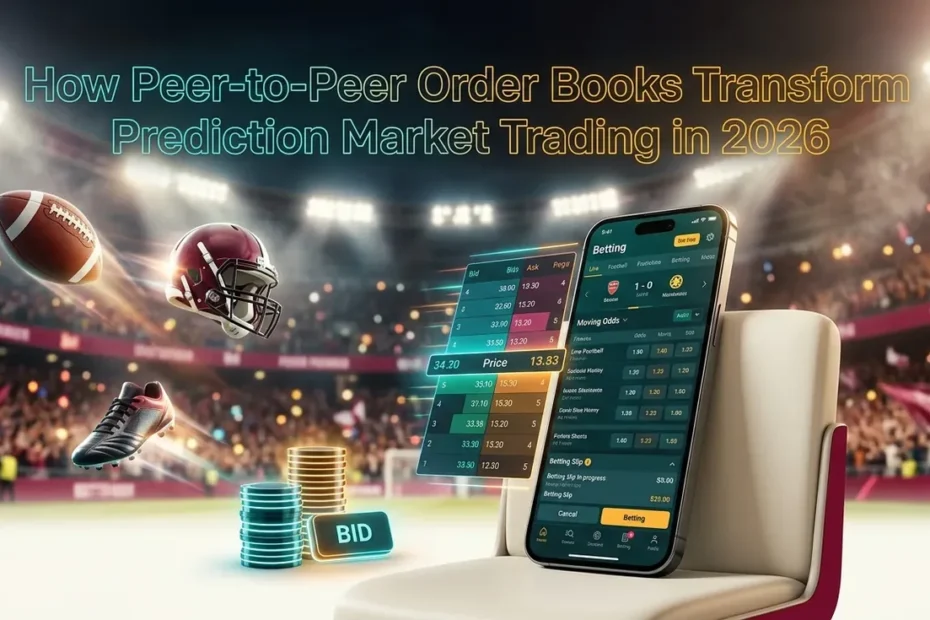
Most prediction sites use a peer-to-peer model. In this setup, traders compete with each other instead of betting against a house that sets the odds. Participants set bids and asks. Prices set by traders replace odds and move with supply and demand. These prices show how the crowd sees an event’s chances. They blend the choices of thousands who back their forecasts with money. In 2025, top prediction sites like https://prediction-pro.com/ handled over $50 billion in volume.
What Peer-to-Peer Order Books Are
Peer-to-peer order books let traders swap event contracts with each other. Traders don’t bet against a house. The exchange matches orders.
Traders set buy or sell orders at their prices. The exchange matches these orders.
This model works differently from the bookmaker model. The house sets the odds and takes on risk for every outcome. Users have more transparency because everyone can see all orders.
How Does the Order Book Mechanism Work?
Order books show the supply and demand of all participants. Bids and asks accumulate at each price level. Traders match the highest bid with the lowest ask, and the difference between the highest bid and lowest ask determines the trading cost.
- Bids stack by price;
- Asks stack by price;
- Spread measures immediate cost;
- Tight spread means agreement;
- Wide spread means disagreement;
- Trades execute when orders cross;
- Aggressive buyers push price up.
Major Exchanges and Their Structure
Top prediction market sites operate under multiple regulatory frameworks and setups. Each exchange uses its own approach to order book infrastructure and trade clearing. These differences determine trade execution speed, influence where liquidity pools form, and determine whether settlement occurs on-chain or through a stack. Some venues run matching engines under CFTC oversight, while others use blockchain-based central limit order books that settle with contracts.
- Kalshi runs own book;
- Polymarket uses blockchain CLOB;
- OG (a blockchain-based prediction market platform) launched February 2026;
- ProphetX registered as DCM;
- FanDuel partners with CME;
- Robinhood uses Kalshi exchange;
- Kalshi Pro for institutions, which are among the best prediction market sites.
Which Contract Types and Market Categories Exist?
In the second half of 2024, sports made up 80% of Kalshi’s volume, while Pew Research found that sports accounted for 39% of Polymarket’s volume during the same period.
- Sports event outcomes;
- Political election results;
- Federal Reserve rate decisions;
- Cryptocurrency price movements;
- Entertainment award winners;
- Business earnings reports;
- Breaking news events;
- Weather and climate data.
Fee Structures Across Exchanges
Venues set up their own fee structures. Most prediction exchanges use the maker-taker model. Takers pay a percentage of the contract value, which varies with the probability.
Polymarket charges fees for taker orders. Maker orders have no fees. To calculate the fee, use this formula: contracts times fee rate times p times (1 minus p). Here, p is the share price.
Polymarket charges $1.56 for that amount. Kalshi charges $1.75 per 100 contracts if each contract costs 50 cents. Kalshi uses this formula: 0.07 times the number of contracts, times the price, times one minus the price. After that, they round up to the nearest cent.
Kalshi offers an annual percentage yield of 3.75 to 4 percent on balances, so someone with $10,000 can earn about $400 in a year. Robinhood charges a flat $0.02 per side for each contract.
Volume and Open Interest Data
Pew Research reports that total monthly volume increased from less than $5 billion in September 2025 to $44 billion in June 2026.
March 2026 brought in $25.7 billion. Volume grew to $44.8 billion by June 2026. This is three times the average monthly sportsbook handle from 2025, which was $14 billion.
In April 2026, Kalshi reported $5.42 billion. Polymarket reported $1.99 billion in the same period. On May 1, 2026, open interest reached $1.11 billion. Kalshi held $630.7 million at that time, while Polymarket held $449.9 million. Together, Kalshi and Polymarket account for 98% of open interest. They hold almost all liquidity. Each month, they process billions in value. People can find thousands of event contracts across sports, politics, and results.
Liquidity Depth and Market Makers
Liquidity shows how quickly people can buy or sell contracts without causing price changes. People check order book depth, bid-ask spread, and trading volume to assess this.
Market makers quote both buy and sell prices at the same time on hundreds of contracts. They earn profit from the spread between these prices. This setup lets other traders enter or exit positions.
Over the last 18 months, liquidity on Kalshi has tripled across different categories. Kalshi has 23 market makers, and the three largest provide 70% of the platform’s election-contract liquidity. On Kalshi, 80% of election trades occur within 0.5% of the mid-price. In April, Polymarket had 678,342 unique users.
Contract Settlement Mechanics
Settlement can end in two ways. If someone makes a correct prediction, they receive $1 for each share. If the prediction is wrong, they receive $0.
Kalshi uses third-party sources set out in contract rules to resolve outcomes. Polymarket uses the UMA oracle and a market integrity committee. When someone disputes an outcome, token holders vote. This vote takes two to four days.
Traders need to check who settles each market and see which source decides the outcome before they trade. Kalshi sends winnings to your cash balance. Polymarket pays out in USDC.
Settlement follows a standard process across prediction markets. Contracts resolve to a final value based on real-world outcomes. The platform determines winners and losers, then distributes funds accordingly. Understanding these mechanics helps traders manage risk and plan their positions.
- Winning contracts resolve to $1 and losing contracts to $0 with no intermediate value;
- The safest contracts name the resolution source up front — official results, league rulings, exchange notices, or other defined public sources;
- You can buy or sell shares at any time before the event concludes.
How Do Prices Reflect Probability?
Buyers and sellers use the order book to choose a price, while contract prices from $0 to $1 reflect the market’s view of an event’s likelihood.
Traders set the probability based on the trade price. If a contract trades at 40 cents, they see a 40 percent chance that the outcome will happen.
Each contract costs between one cent and ninety-nine cents. If the event takes place, it pays one dollar. The price for a Yes contract and a No contract together is one dollar.
The gap between the bid and ask sets the cost to enter or leave a trade. A Yes contract priced at 60 cents shows a 60 percent chance that the event will happen.
Trader Types and Fit
Many traders want contracts with spreads below three cents. They look for notional liquidity in the six- or seven-figure range. Spreads and liquidity matter to these traders.
Position traders keep contracts for a long time. They focus on settlement instead of spread. Kalshi pays 3.75 to 4 percent APY on unused funds.
Arbitrage traders exploit price gaps across exchanges and between Yes and No contracts to make trades. Market makers, who pay no fees, provide liquidity by quoting both buy and sell prices. They earn the spread and a share of taker fees, which incentivizes their participation.
Conclusion
Traders set prices now. The house does not. Peer-to-peer order books changed prediction markets in fact. Monthly trading volume grew from under $100 million to over $40 billion. People use these markets to trade on sports, politics, crypto, and financial events. Before joining markets where contract prices show probability, traders need to know how order books, fees, and settlement work. Liquidity depth shapes how trades get matched and what it costs to trade.